
Go from “I didn’t know that” to “Did you hear the Niuz?”
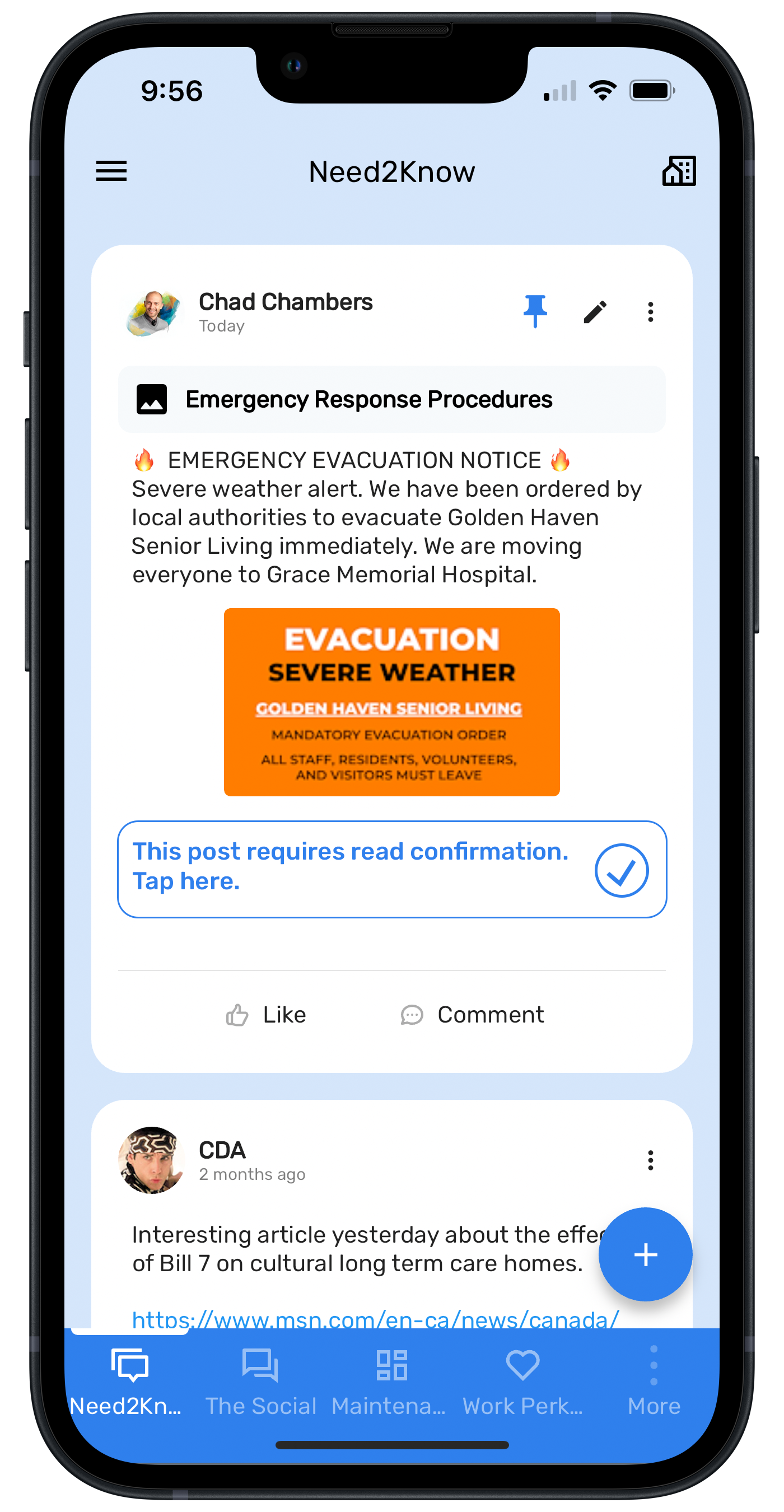
Niuz is a staff communication platform that lets you share the alert that can’t wait, the policy you updated, the kudos that didn’t make it past the bulletin board, the schedule changes you emailed. To every member of your senior care team.
Wherever they are. With proof they got it.
You sent the message. Now what?
Long-term care runs on dozens of decisions a day that depend on the right information reaching the right people at the right time. When the information doesn’t travel, here’s what it looks like in your week.
You emailed the schedule updates
Three team members didn’t show on Thursday. They said they never saw the email.
You printed the new IPAC policy
The incident report stalls because you can’t prove the policy reached the people who were involved.
You needed the night shift to know about the new fire drill protocol
You hoped the day shift would pass it on. You won’t find out whether they did until something goes wrong.
You wrote a thank-you note for the team that pulled off survey week
You posted it on the staff board. Two of the people it was for never saw it. Then it got covered up by a new schedule sheet.
This is what "I didn't know that" actually costs you.
Missed shifts. Failed audits. Conversations with surveyors and families you’d rather not be having. And recognition that doesn’t land because the message doesn’t reach the people it was meant for.
96% of staff said Niuz improved communication
Rosedale Home for Special Needs
Frontline staff turnover is down by 80% with Niuz
Crown Ridge Health Care Services
The tools you’ve been using aren’t reaching your team anymore.
Email
Checked once a week, if that.
Bulletin board
Walked past without a glance.
Printed memos
Buried behind 26 other things.
Shift huddles
Nine people make it.
The rest don’t
Group texts
Random phone numbers and random responses.
WhatsApp
A group nobody owns and not everyone’s in.
Facebook groups
A privacy concern you don’t want to own.
Built-in messaging
Other platforms bolted it on, but not well.
Your team isn’t avoiding the message.
The message is just somewhere they don’t check.
The fix isn’t a better tool.
It’s a decision.
The decision to give your team one place where the updates, the recognition,
and the questions all live together, and to use it consistently.
Niuz is what that decision looks like in practice.
One tool. Many uses. Used consistently.
Niuz is the place where the operational updates, the recognition, and the questions live together. Each of the things listed below is useful on its own. Using them all in the same place consistently is what makes Niuz the tool your team actually checks.
Reach beyond the patchwork.
Share the schedule you posted in Excel. The policy update from this morning. The training reminder for next week. The emergency alert that can’t wait. Updates reach every member of your team, on whatever device they have in front of them – phone before and after shift, tablet or desktop at the nursing station, wherever they frequent. One place, not eight.


See who saw what.
Add a read confirmation to any post and see exactly who has and hasn’t opened it. Follow up where it matters. Have proof when it counts. The next time someone says “I didn’t know that,” you both know whether it’s true.
Recognize the team in front of everyone.
Kudos, shout-outs, and peer-to-peer thanks live in the same place as the operational updates. Recognition stops being something you mean to do at the next staff meeting and becomes something that happens in the moment, in front of the people whose opinions matter more to your team.


Find out what your team thinks – without making it a project.
Satisfaction surveys and pulse checks you’d normally need another platform for and another few hours in your day. Niuz makes them simple to create, send, and report on – no separate tool, no separate budget line, no separate login or password. The feedback you’ve been flying without becomes the signal you check on the way to your next meeting.
Subscribe to The Buzz!
We share interesting stuff every month about communication, recognition, culture building, and more. No, really. Subscribe today.

What changes when the message actually reaches everyone
Niuz is used in long-term care and senior living homes across Canada and the United States. The homes that adopt it see a pattern: staff engagement goes up, communication gaps close, and the people who show up every day start to feel like they belong to something worth staying for.
“We really feel connected now to each other and as an organization because everyone’s using Niuz.”
Administrator, LTC

“Before Niuz, I was onboarding up to 20 new staff every month. After Niuz, that number has dropped to 4 or less.”
HR Manager

“Niuz has been a great and easy way to improve communications with our teams.”
Director of Nursing, LTC

We're proud members of







Create the environment you’ve always wanted at work.
See how Niuz helps long-term care homes turn staff communication into culture,
and culture into retention.